The Quest for
Surf City
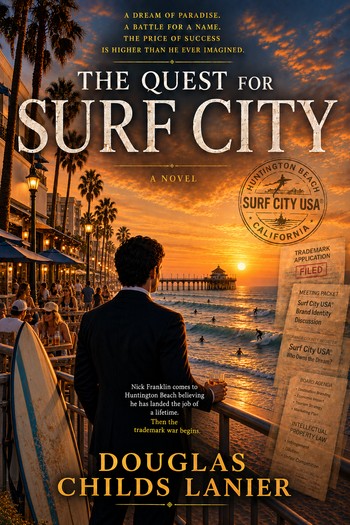
Inspired by real events.
Nick Franklin comes to Huntington Beach believing he has landed the job of a lifetime: promote paradise, build something lasting, and finally give his family a place to call home after years of moving from city to city.
The city is sunlit and seductive. Surfers drift beneath his office balcony. Hotel owners talk growth over cocktails beside the Pacific. Politicians promise partnership. The beaches seem endless.
Then the trademark war begins.
What starts as a civic branding dispute with Santa Cruz over the name SURF CITY USA grows into a battle fought in the media, the state legislature, and ultimately federal court, as political alliances shift, loyalties are tested, and Nick becomes increasingly determined to defend the brand he helped build.
As the stakes grow, the line between selling the dream and living inside it begins to disappear.
The Quest for Surf City is a novel about ambition, belonging, reinvention, and the stories people build around places, institutions, and themselves. It is about the creation of modern myths, the power hidden inside a name, and the cost of giving ourselves over to something larger than ourselves.
Why I Wrote It
I’ve read novels about doctors, lawyers, firefighters, police officers, private investigators, and countless other professions. But I’ve never encountered a novel that takes readers inside a destination marketing organization (DMO). What happens behind the brochures, advertisements, websites, and slogans designed to persuade people to visit a place? I know that world intimately. I wanted to bring readers inside it too.
The transformation of Huntington Beach’s tourism organization and the events that eventually led to its trademark battle with Santa Cruz gave me the story through which to do it. The dispute pitted two of America’s best-known surfing communities against one another and generated headlines around the world. Having lived through it, I didn’t want to see that extraordinary chapter in the history of place branding simply fade away.
There was another attraction for me. I promised myself for most of my life that someday I would finish a novel. There are nine other attempts still sitting in my credenza in various forms of completion. Of all the manuscripts I have started, this was the one I had come closest to finishing. I began it eighteen years earlier, sitting on the balcony of the historic Zane Grey Pueblo Hotel in Avalon, California, while the details were still fresh in my mind. This was the one I believed could finally turn my lifelong ambition into something real. I had to finish it.

The irony is that I have never been a surfer, unless body surfing counts. After years of watching it and learning about it, I came to understand why surfing provides such a powerful metaphor for life. We spend much of our time waiting for something to happen, trying to recognize the right opportunities before they pass, and deciding which ones to take. Sometimes we catch a wave and ride it farther than we imagined. Sometimes it throws us against a piling.
The Quest for Surf City gave me an opportunity to transform a version of my California experience into fiction, concentrating years of events and personalities into a fast-moving story. I wanted the characters to reveal themselves the way people reveal themselves to me: through what they say, what they do, and the choices they make. I don’t tell readers what to think about them. You get to decide for yourself.
Why This Story Matters
Most people have probably encountered the work of a destination marketing organization without ever knowing one exists.
A photograph that makes you imagine yourself on a particular beach. An advertisement that puts a city on your list of places to visit. A website, visitor guide, social media post, or slogan that quietly changes the way you think about a destination. Behind many of those impressions are organizations devoted to influencing where people travel.
The scale of this largely invisible industry may be surprising. In fiscal year 2025, state tourism offices in the United States alone spent $1.12 billion on tourism marketing, according to the U.S. Travel Association. Their combined budgets totaled $1.79 billion. Those figures do not encompass the thousands of local and regional organizations promoting individual cities, counties, and regions. Worldwide, there are more than 10,000 destination organizations.
Yet most travelers would be hard-pressed to name the organization marketing the destination they are visiting or even promoting the area where they live.
The work can be everywhere while the organizations behind it remain nearly invisible.
Much of destination promotion is funded through revenues associated with visitor activity, particularly taxes and assessments on overnight accommodations. Residents can therefore live in a community for decades, benefit from its visitor economy, and know remarkably little about the organization working to attract those visitors. Yet DMOs help answer a deceptively simple question: What story should we tell about this place?
I didn’t write The Quest for Surf City as a textbook about destination marketing. I wanted readers to experience that world instead: the personalities, ideas, arguments, politics, risks, victories, and occasional absurdities involved in persuading people to visit one place instead of another.
There is also a historical reason this story matters.
I LOVE NY® Surf City USA® Virginia is for Lovers® What Happens Here, Stays Here.®
Destination marketing has created some of the most enduring expressions of place in American culture. The brands become more than advertising campaigns. They become part of the identities of the places themselves. I believe the historical significance of Surf City USA® is still unfolding.
The resulting conflict with Santa Cruz produced headlines around the world. But the questions it raised reach beyond two California beach towns. Who owns an identity associated with a place? Can civic identity become intellectual property? What happens when culture, commerce, community pride, and trademark law all lay claim to the same name?
Then there is the story within the story.
The Quest for Surf City is also about ambition, loyalty, competition, politics, friendship, reputation, and the complicated relationship between people who build institutions and the institutions they help build.
Nick Franklin believes in results, that if he succeeds in the job he was hired to do, success will provide its own protection. Readers can decide for themselves at the end of the novel whether he is right.